

 English
At its February 18 meeting, and after a deliberate review process that considered member impacts and cooperative responsibilities, the Holy Cross Energy Board of Directors approved the following changes to the Electric Service Tariffs, Rules, and Regulations, effective April 1, 2026.
Why was a rate increase necessary?
The co-op is also facing significantly higher charges for the transmission services and power we purchase from Xcel Energy, beginning in 2026.
While our shift to cleaner energy sources has helped soften some of these increases, it hasn’t removed them entirely.
Our staff has worked to counter as many of these increased costs as possible, by carefully reviewing budgets, delaying non-essential capital projects, and identifying opportunities for savings that don’t jeopardize the safety or reliability of our service.
Unlike past rate increases that focused mainly on the Energy Charge or fixed Customer Charge, this adjustment introduces or raises the monthly Demand Charge for all members.
This change begins to more accurately reflect our rising infrastructure and transmission costs, while also still giving you control over your bill by reducing your individual peak demand.
All members will now see a Demand Charge on their monthly bill:
Individual bill impacts will vary depending on how and when you use energy:
For years, your electric bill was based primarily on how much electricity you consumed, as a large portion of our costs came from the electricity we purchased for you. However, the financial landscape of the power grid has shifted dramatically over the last few years:
The electric charges on your bill will now be divided into two parts:
Energy Charge (kWh)
Demand Charge (kw)
To understand your new bill, it helps to distinguish between the two ways we measure electricity:
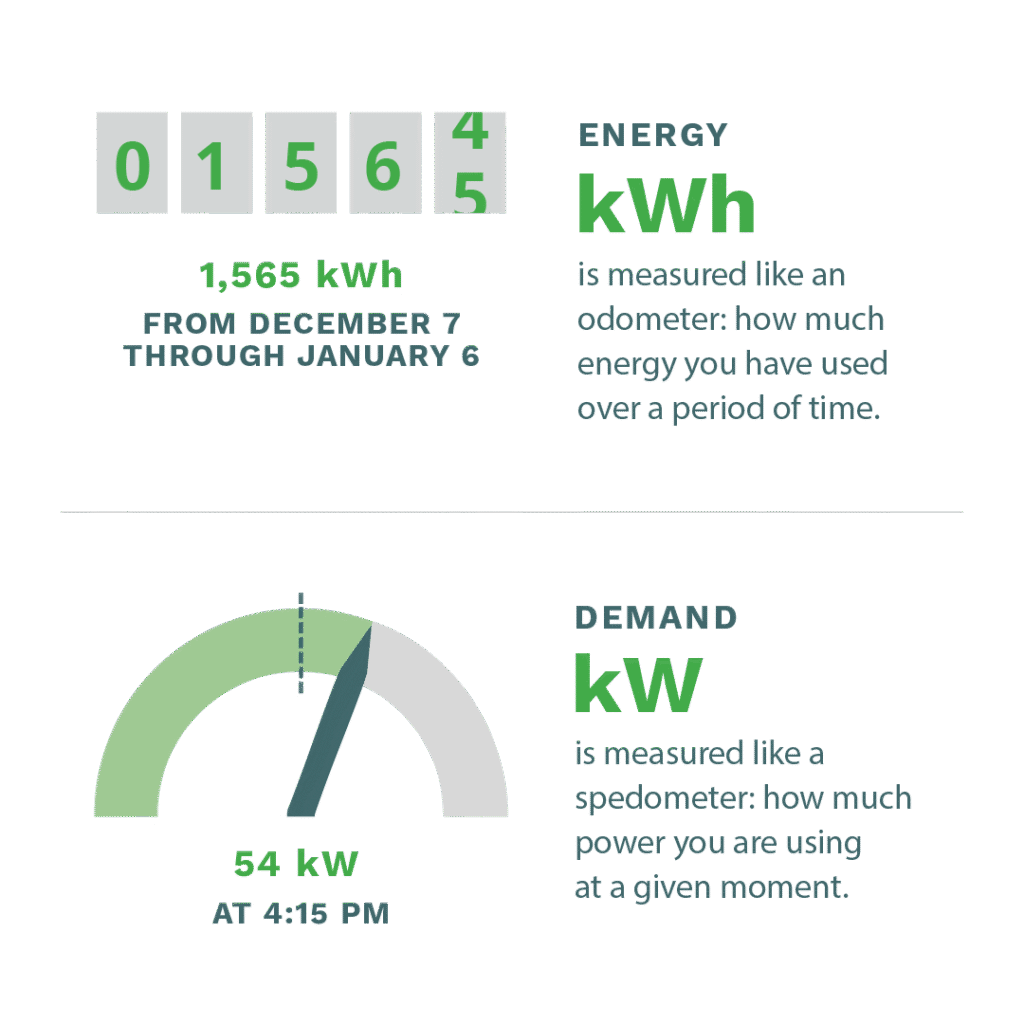
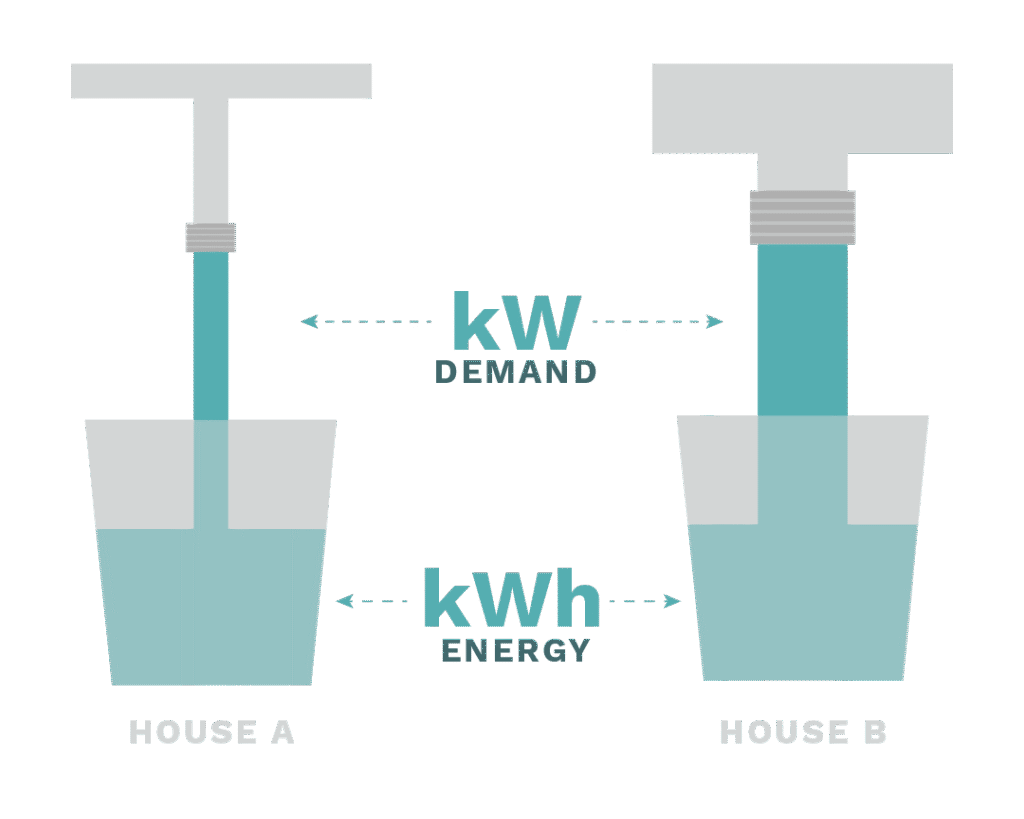
Since water is more tangible than electricity, it’s helpful to compare the electric grid to a system of water pipes when thinking about demand:
A house that requires more water at once necessitates larger, more expensive utility pipes to supply that amount of water quickly.
Similarly, a house that requires more electricity at once requires stronger, more expensive utility electrical infrastructure to provide that energy so quickly.
An “All-at-Once” or “Stacked” Approach
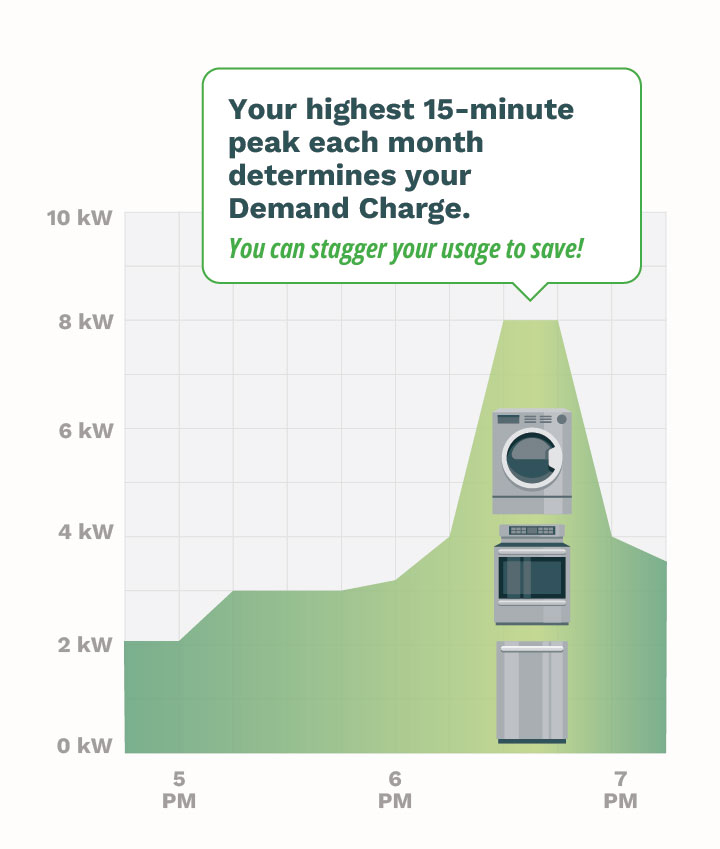
It’s 6:00 p.m. You have the electric oven on (approx. 4 kW) and you start the electric dryer (approx. 4 kW) at the same time.
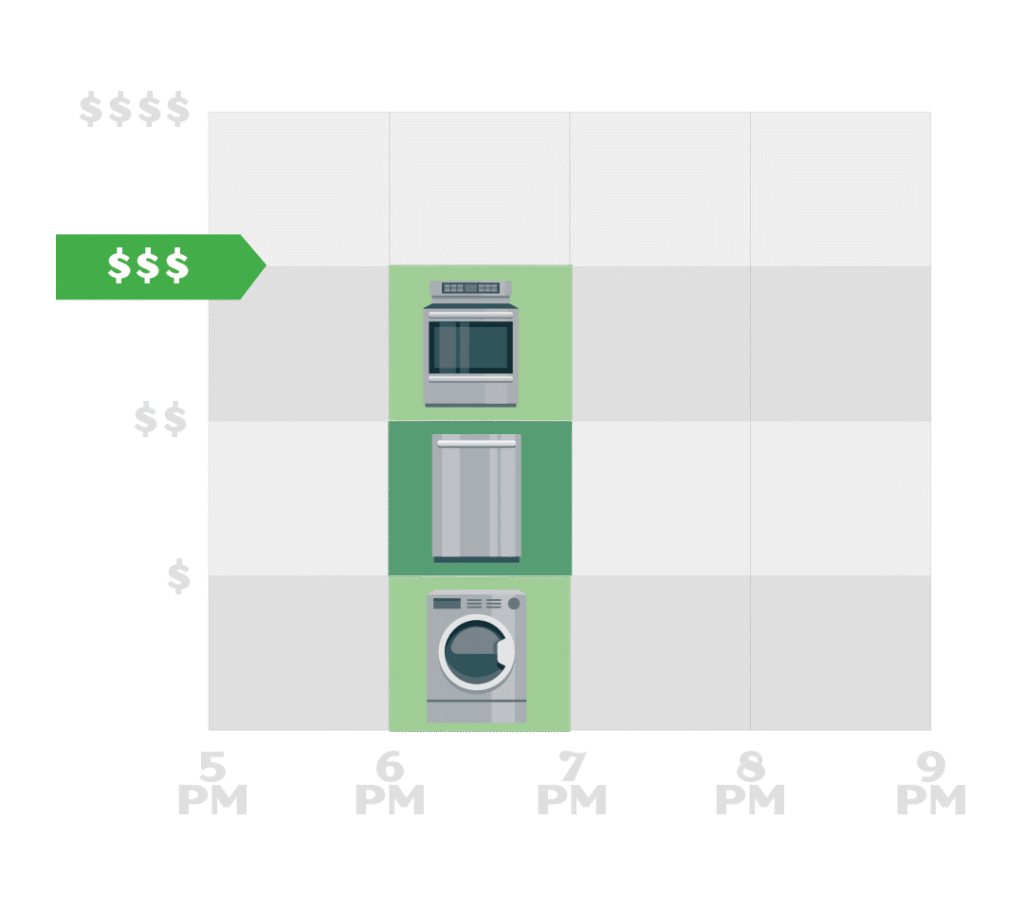
Running several appliances at once increases your demand, increases the strain on the grid, and will lead to a higher bill.
A “Staggered” Approach
You cook dinner at 6:00 p.m. using the oven. You wait until after you’re done cooking, say 8:00 p.m., to start the electric dryer.
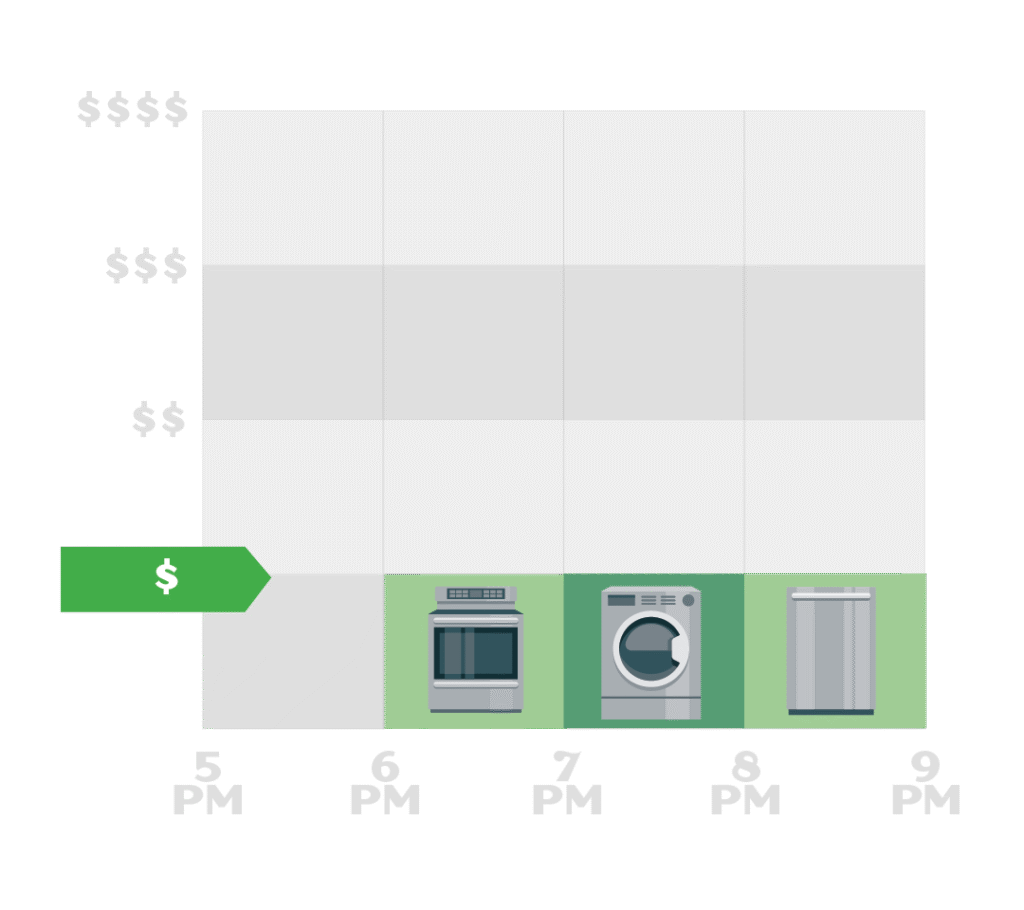
Staggering your appliance usage throughout the day will lead to a lower demand, will lessen the strain on the grid, and can lead to savings on your bill.
Think of each large appliance like its own little peak. If you use several of them at once, you create a higher peak.
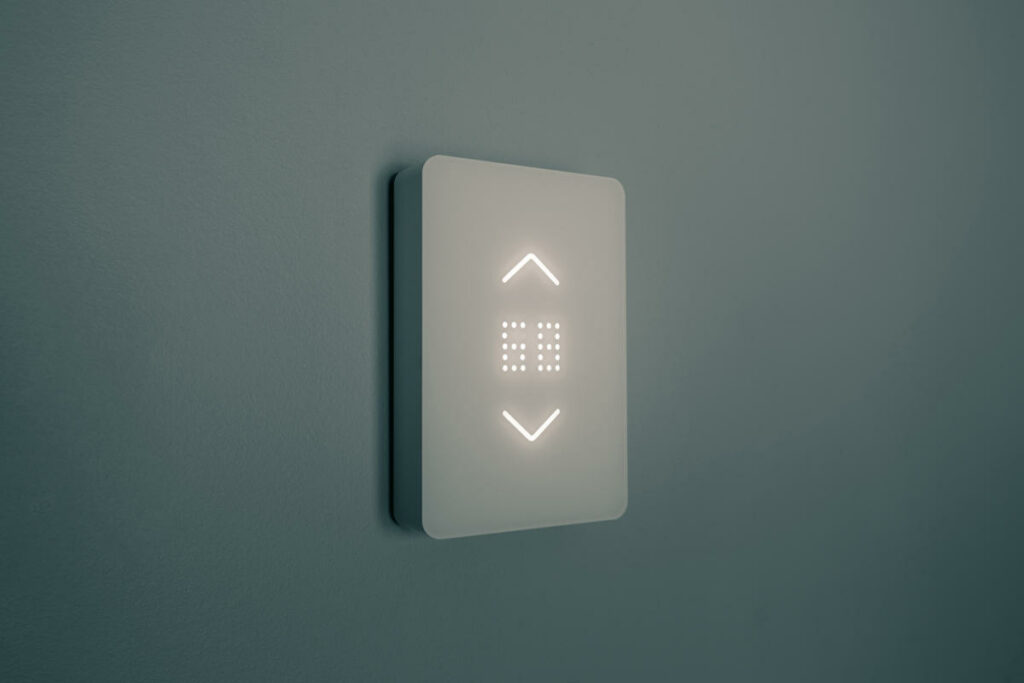
Programmable thermostats and smart devices can help you save. Set a schedule to keep your flexible appliances off during times of the day when you use more electricity.
The Demand Charge is based on the single highest level of electricity you require during your monthly billing cycle. We have already been measuring this number for years, but have not been charging for it in our Small Residential and Small Commercial rate classes.
Measurement: we calculate the highest 15-minute window of demand during the month.
Rate: we charge a certain amount per kW measured during that window, with the amount depending on your rate class.
99% of our residential members fall under the Small Residential rate category. You qualify as Small Residential if your monthly demand reading is less than 50 kW.
Small Residential |
Previous Rate |
New Rate (April 2026) |
|---|---|---|
|
Energy Charge (per kWh) |
$0.11 |
$0.11 |
|
Demand Charge (per kW) |
$0.00 |
$1.00 |
Small Commercial |
Previous Rate |
New Rate (April 2026) |
|---|---|---|
|
Energy Charge (per kWh) |
$0.10 |
$0.10 |
|
Demand Charge (per kW) |
$0.00 |
$1.00 |
Large Residential |
Previous Rate |
New Rate (April 2026) |
|---|---|---|
|
Energy Charge (per kWh) |
$0.082 |
$0.082 |
|
Demand Charge (per kW) |
$5.32 |
$5.51 |
Large Commercial & Irrigation |
Previous Rate |
New Rate (April 2026) |
|---|---|---|
|
Energy Charge (per kWh) |
$0.078 |
$0.078 |
|
Demand Charge (per kW) |
$6.11 |
$6.38 |
Customer Charge
There is no change to your Customer Charge, the fixed monthly charge that is the basic fee for your electric service.
Electric Cost Adjustment (ECA)
The ECA is used to achieve a uniform and consistent annual rate of return. This number fluctuates monthly as actual monthly operating revenue and expenses become available. We estimate an initial ECA for 2026 of $0.0025 per kWh.
WE CARE Surcharge
There is no change to WE CARE, which funds energy efficiency and conservation measures as well as renewable energy generation.
Since everyone has differing levels of electricity demand, and a household’s own demand even varies from month-to-month, there will be differing impacts to your monthly bills.
Grab some of your past bills (available online through your SmartHub account) and plug in your Energy and Demand readings to calculate how much that month’s bill would be under the new rate structure.
On the back side of your bill, look for the lines labeled Energy Charge and Demand Charge. Enter the values under the Usage Units column:
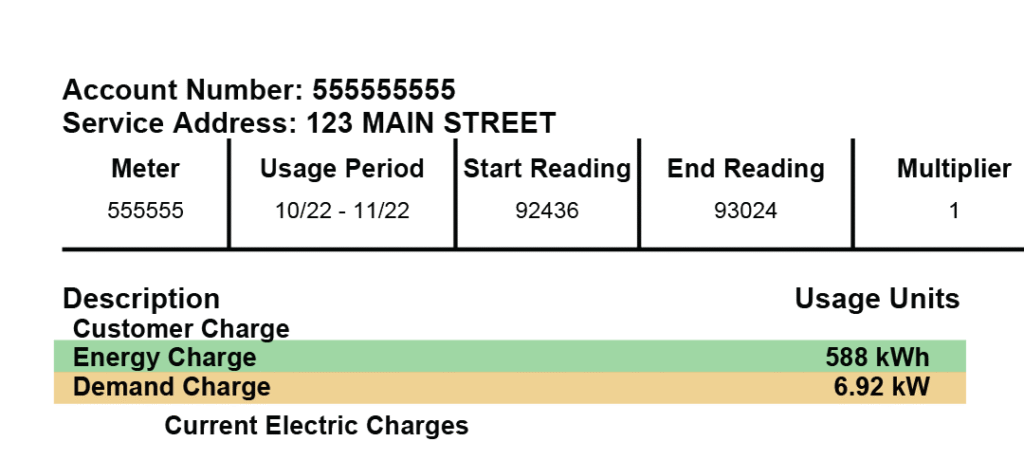
Additional charges on the bill are not featured here, including the 2% WE CARE charge, and any applicable local taxes and fees.
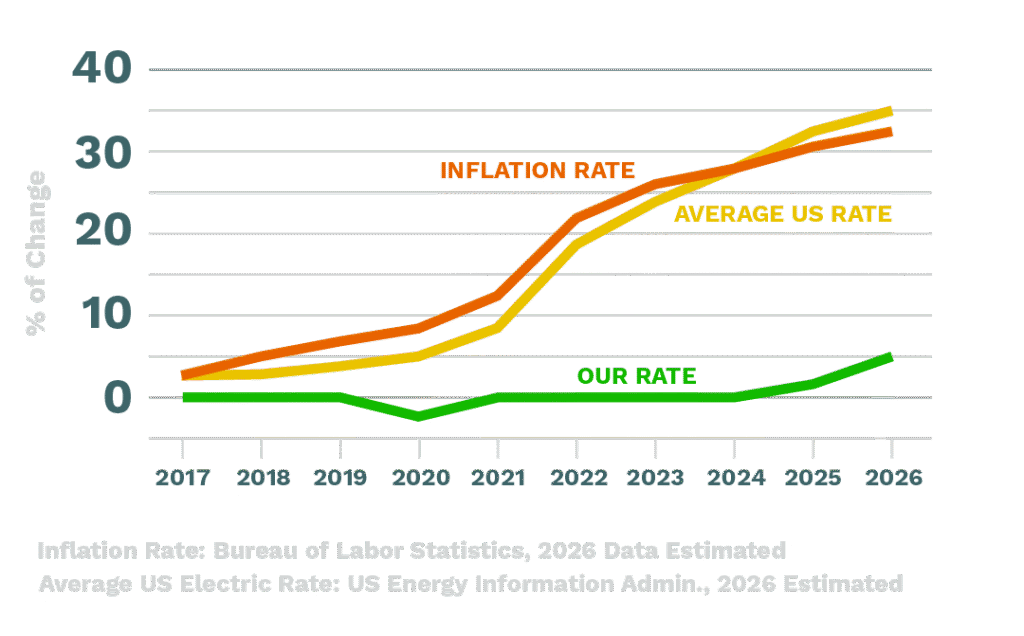
Concept for now — this graph needs actual HCE #s and confirmation of other #s
Our optional Time of Use rate may be a great path to savings for members who can be highly flexible with their use of major appliances, devices, and electric heating and cooling.
Members who enroll in Time of Use will not incur a Demand Charge and can take advantage of “off-peak” electric rates, which are four times lower than “on-peak” rates.
Can you shift most of your electric use to outside of 4:00-9:00 p.m.? Time of Use might be a great fit for you!
Energy Charge
Demand Charge
Getting the most out of your solar
Unlike other members, solar net metering members have the advantage of using their solar wisely to help reduce their monthly demand. You can reduce your demand by:
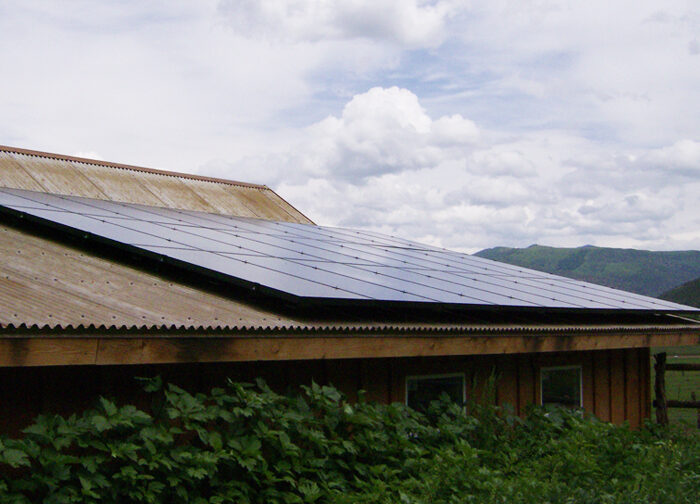
If you have solar, you can use your biggest electric appliances when the sun is shining to help reduce your demand and your bill.
We understand the potential hardships that our members may face when paying their utility bills. We are proud to partner with the organizations below to help those who need assistance.
If you qualify based on your income level, we are happy to help you apply for the following programs and services:
Our Member Services team is happy to assist you in navigating these resources.
Call us at 970.945.5491.
Minimize the financial impact of large seasonal electric energy bills.
Members receiving residential service in a single dwelling (excludes all multiple dwelling service members) are eligible to minimize the impact of large seasonal electric energy bills by using our Budget Billing Plan.
If you have questions about the upcoming changes, please complete the form below and we’ll get back to you within a few business days.